Publications
2025
Krimm, TImon; Hatzissawidis, Grigorios; Ludwig, Gerhard; Kuhr, Maximilian; Pelz, Peter
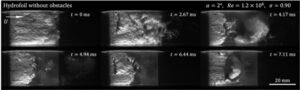
The influence of regular surface patterns on cloud cavitation about a hydrofoil Conference
IOP Conference Series: Earth and Environmental Science, vol. 1561, no. 1, IOP Publishing, 2025.
@conference{nokey,

title = {The influence of regular surface patterns on cloud cavitation about a hydrofoil},

author = {TImon Krimm and Grigorios Hatzissawidis and Gerhard Ludwig and Maximilian Kuhr and Peter Pelz},

url = {https://grigorioshatzissawidis.de/wp-content/uploads/2025/12/Krimm_2025_IOP_Conf._Ser.__Earth_Environ._Sci._1561_012009.pdf},

doi = {10.1088/1755-1315/1561/1/012009},

year  = {2025},

date = {2025-11-01},

urldate = {2025-11-01},

booktitle = {IOP Conference Series: Earth and Environmental Science},

volume = {1561},

number = {1},

pages = {012009},

publisher = {IOP Publishing},

abstract = {Two hydrofoils with different obstacle configurations were examined in the cavitation tunnel at Technische Universität Darmstadt to quantify the influence of the obstacles on cavitation dynamics. Both the cavitation number and the incidence were varied. High-speed imaging and high-frequency pressure measurements were conducted to identify characteristic time scales (shedding frequency) and length scales (cavity sheet length). The power spectral density (PSD) of the pressure data was estimated to isolate the characteristic shedding frequencies of cloud cavitation. The examination of the cavitation topology and spectra enables the separation between (i) condensation shockwave and (ii) re-entrant flow as dominant cloud shedding mechanism. The influence of the obstacles is primarily visible in a reduction of shedding frequencies correlated to the re-entrant flow. In addition, there is an effect on the frequencies associated with shockwave-driven cloud cavitation, which could be related to the hindrance of the re-entrant flow. The cavity sheet was automatically detected using a convolutional neural network (CNN). Two methods were applied to obtain the average and maximum cavity sheet length. As expected, the extent of the cavity sheet increases as the cavitation number is reduced. The influence of the obstacles on the cavity sheet length is only apparent if an obstacle is located close to the leading edge.},

keywords = {},

pubstate = {published},

tppubtype = {conference}

}
Hatzissawidis, Grigorios; Sieber, · Moritz; Pelz, Peter F.
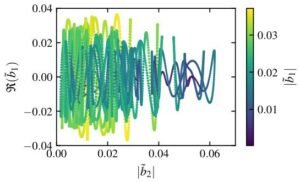
Identification of Dominant Modes for Cavitating Flows using Spectral Proper Orthogonal Decomposition Conference
Topics in Modal Analysis & Parameter Identification I, Proceedings of the 43rd IMAC, A Conference and Exposition on Structural Dynamics 2025, vol. 9, River publishers, 2025, ISBN: 9788743801542.
@conference{Hatzissawidis2025ident,

title = {Identification of Dominant Modes for Cavitating Flows using Spectral Proper Orthogonal Decomposition},

author = {Grigorios Hatzissawidis and · Moritz Sieber and Peter F. Pelz},

url = {https://grigorioshatzissawidis.de/wp-content/uploads/2025/11/imac_paper_hatzissawidis.pdf},

doi = {10.13052/97887-438-0154-2_13},

isbn = {9788743801542},

year  = {2025},

date = {2025-08-01},

urldate = {2025-08-01},

booktitle = {Topics in Modal Analysis & Parameter Identification I, Proceedings of the 43rd IMAC, A Conference and Exposition on Structural Dynamics 2025},

volume = {9},

pages = {111 - 120},

publisher = {River publishers},

abstract = {Cavitating flows exhibit complex, chaotic, multimodal, and intermittent behaviour. The dominant flow patterns are often hidden to the naked eye. Classical methods such as Proper Orthogonal Decomposition (POD) or Dynamic Mode Decomposition/Discrete Fourier Transformation (DMD/DFT) often fail to decompose the flow field into physically meaningful modes. To overcome this problem, we apply Spectral Proper Orthogonal Decomposition (SPOD). Using this method, it is possible to continuously shift between POD and DFT by varying a single parameter called filter size which is applied to the correlation matrix between the individual snapshots. In this paper, SPOD is applied to high-speed images of cloud cavitation in the top and side view. We demonstrate that by appropriately varying the filter size, it is possible to decompose the data into the physical meaningful dominant modes. The intrinsic feature of SPOD to conduct a transient analysis through the time coefficients facilitates the understanding of the physical mechanisms corresponding to a specific mode. We show how the filter size affects the SPOD results and demonstrate how SPOD provides a more meaningful basis for modal representation of the images than POD and DMD/DFT. We perform a transient analysis to capture the intermittent flow behaviour, characterised by switching between two dominant modes as well as the presence of higher harmonics. Furthermore, extended SPOD (eSPOD) is applied to simultaneously captured pressure data along with the high-speed imaging, providing the correlation between the SPOD time coefficients and the pressure data.},

keywords = {},

pubstate = {published},

tppubtype = {conference}

}
Hatzissawidis, Grigorios; Kuhr, Maximilian M. G.; Pelz, Peter F.
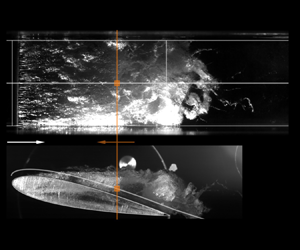
The transition from re-entrant flow-driven to shockwave-driven cloud cavitation Journal Article
In: Journal of Fluid Mechanics, vol. 1004, pp. A13, 2025, ISSN: 0022-1120.
@article{Hatzissawidis2025b,

title = {The transition from re-entrant flow-driven to shockwave-driven cloud cavitation},

author = {Grigorios Hatzissawidis and Maximilian M. G. Kuhr and Peter F. Pelz},

url = {https://grigorioshatzissawidis.de/wp-content/uploads/2025/05/the-transition-from-re-entrant-flow-driven-to-shockwave-driven-cloud-cavitation.pdf},

doi = {10.1017/JFM.2024.1224},

issn = {0022-1120},

year  = {2025},

date = {2025-01-01},

urldate = {2025-01-01},

journal = {Journal of Fluid Mechanics},

volume = {1004},

pages = {A13},

publisher = {Cambridge University Press},

abstract = {Understanding the mechanism of hydrodynamic cloud cavitation is crucial to reducing noise, vibration and wear. Recent studies have clarified the physics of two distinct formation mechanisms of cloud cavitation. Ganesh et al. (J. Fluid Mech., vol. 802, 2016, pp. 37–78) identified the propagation of bubbly shockwaves as a cloud detachment mechanism. Pelz et al. (J. Fluid Mech., vol. 817, 2017, pp. 439–454) explained the influence of Reynolds number and cavitation number on asymptotic growth of the cavity sheet and its periodic shedding caused by re-entrant flow. In this paper the two mechanisms are set in relation to each other. For this, we show firstly that the transition from re-entrant flow to shockwave-driven cloud cavitation is given by a kinematic condition, namely the asymptotic sheet length equates to the chord length, that is calculated analytically and validated by experiments. Secondly, we derive the relationship between the Strouhal number and the asymptotic sheet length for re-entrant flow-driven cloud cavitation. The model presented here is thoroughly validated by experiments.},

keywords = {},

pubstate = {published},

tppubtype = {article}

}
Hatzissawidis, Grigorios; Sieber, · Moritz; Oberleithner, · Kilian; Peter, ·; Pelz, F
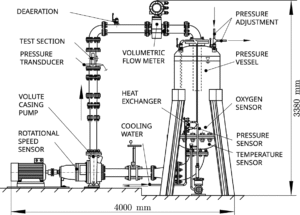
Data-driven spatiotemporal analysis of cloud cavitation by means of spectral proper orthogonal decomposition Journal Article
In: Experiments in Fluids, vol. 66, iss. 5, pp. 104, 2025, ISSN: 1432-1114.
@article{Hatzissawidis2025,

title = {Data-driven spatiotemporal analysis of cloud cavitation by means of spectral proper orthogonal decomposition},

author = {Grigorios Hatzissawidis and · Moritz Sieber and · Kilian Oberleithner and · Peter and F Pelz},

url = {https://grigorioshatzissawidis.de/wp-content/uploads/2025/05/s00348-024-03949-z.pdf},

doi = {10.1007/S00348-024-03949-Z},

issn = {1432-1114},

year  = {2025},

date = {2025-01-01},

urldate = {2025-01-01},

journal = {Experiments in Fluids},

volume = {66},

issue = {5},

pages = {104},

publisher = {Springer},

abstract = {The global dynamics of cloud cavitation are not always obvious; cloud cavitation may exhibit chaotic, multimodal and intermittent behaviour, where dominant flow structures are hidden to the naked eye. To address this, spectral proper orthogonal decomposition (SPOD) is applied, a method that can continuously transition between proper orthogonal decomposition (POD) and discrete Fourier transformation (DFT)/dynamic mode decomposition (DMD). This provides the opportunity to break down the complex dynamics of interacting and transient processes into interpretable modal bases. Experiments were conducted in a high-speed cavitation tunnel using a two-dimensional NACA 0015 hydrofoil at a fixed Reynolds number of $$8 times 10^5$$ and an incidence of $$12^circ$$ for varying cavitation numbers. The cavitation was recorded using a synchronised dual-camera set-up with simultaneously captured pressure signals. Shockwave-driven and re-entrant flow-driven cloud shedding is identified, as well as the transition regime in between, exhibiting more complex behaviour. The transition from shockwave-driven to re-entrant flow-driven cloud cavitation is smooth, with shockwaves becoming more dominant as the cavitation number decreases. SPOD modes allow for a frequency and amplitude variation, which successfully decomposes the data into the dominant modes, whereas classical modal decomposition methods such as POD and DMD do not provide interpretable decompositions. SPOD grants access to a transient analysis of the data via the SPOD time coefficients. We validate the SPOD results using space–time plots and power spectral density (PSD) of the pressure signals, being in good agreement with the SPOD spatial modes and time coefficients. The complex time coefficients give access to instantaneous mode frequencies and allow calculating a standard deviation of the frequency modulation of the modes. The findings provide a deep insight into the spatial and temporal behaviour of cloud cavitation and support the understanding of its physics.},

keywords = {},

pubstate = {published},

tppubtype = {article}

}
2022
Hatzissawidis, Grigorios; Kerres, Lara; Ludwig, Gerhard J.; Pelz, Peter F.
Spatiotemporal analysis of sheet and cloud cavitation and its damage potential Conference
IOP Conference Series: Earth and Environmental Science, vol. 1079, no. 1, IOP Publishing, 2022.
@conference{Hatzissawidis_2022,

title = {Spatiotemporal analysis of sheet and cloud cavitation and its damage potential},

author = {Grigorios Hatzissawidis and Lara Kerres and Gerhard J. Ludwig and Peter F. Pelz},

url = {https://grigorioshatzissawidis.de/wp-content/uploads/2025/12/Hatzissawidis_2022_IOP_Conf._Ser.__Earth_Environ._Sci._1079_012046.pdf},

doi = {10.1088/1755-1315/1079/1/012046},

year  = {2022},

date = {2022-09-01},

urldate = {2022-09-01},

booktitle = {IOP Conference Series: Earth and Environmental Science},

journal = {IOP Conference Series: Earth and Environmental Science},

volume = {1079},

number = {1},

pages = {012046},

publisher = {IOP Publishing},

abstract = {The cavitation regime has a substantial influence on the damage potential, thus it has to be considered in any specific investigation. For this purpose, we set up a test rig at the Technische Universität Darmstadt using a Circular Leading Edge hydrofoil (CLE) to analyse the damage potential of sheet and cloud cavitation. Exceeding a critical Reynolds number Re c, the cavitation regime transitions from harmless sheet cavitation to aggressive cloud cavitation. High-speed recordings of the cavitation regime are correlated with high frequency pressure data from a wall-mounted piezoelectric pressure transducer. Spatial and temporal content of the cavitating flow are captured applying proper orthogonal decomposition (POD) to the high-speed recordings. In order to determine the damage potential of the cavitation regime we apply a copper foil on the hydrofoil surface, on which plastic, crater-shaped deformations due to bubble collapses occur. Images of the surface are recorded before and after each run via two-dimensional Pit-Count microscopy. We correlate spatial modes from the cavitating flow field with the eroded surface rate from pitting tests leading to the result that cloud cavitation associated with increasing cloud size is more aggressive. A power law is identified where pitting rate increases with fourteenth power of the Reynolds number.},

keywords = {},

pubstate = {published},

tppubtype = {conference}

}
2021
Hatzissawidis, Grigorios; Ludwig, Gerhard J.; Pelz, Peter F.
Modal Decomposition of Large- and Small-Scale Cloud Cavitation Conference
IOP Conference Series: Earth and Environmental Science, vol. 774, no. 1, IOP Publishing, 2021.
@conference{Hatzissawidis_2021,

title = {Modal Decomposition of Large- and Small-Scale Cloud Cavitation},

author = {Grigorios Hatzissawidis and Gerhard J. Ludwig and Peter F. Pelz},

url = {https://grigorioshatzissawidis.de/wp-content/uploads/2025/12/Hatzissawidis_2021_IOP_Conf._Ser.__Earth_Environ._Sci._774_012097.pdf},

doi = {10.1088/1755-1315/774/1/012097},

year  = {2021},

date = {2021-06-01},

urldate = {2021-06-01},

booktitle = {IOP Conference Series: Earth and Environmental Science},

journal = {IOP Conference Series: Earth and Environmental Science},

volume = {774},

number = {1},

pages = {012097},

publisher = {IOP Publishing},

abstract = {Cavitation clouds cover a frequency ω and wavenumber k spectrum limited by an upper bound due to the span of a blade or the diameter of a nozzle. The lower bound is given by the size of the eddies of a turbulent flow. Interpreting cavitation clouds as ring vortices and the formation as a challenge between re-entrant jet and asymptotic sheet growth, this becomes clear. To investigate the temporal and spatial contain of cavitation clouds, experiments were conducted on an unmodified and a modified hydrofoil with an artificial roughness i.e. an obstacle. From the high-speed measurements, we observe two cavitation regimes, (i) periodic large-scale cloud cavitation for the modified and (ii) small-scale cloud cavitation for the unmodified hydrofoil. For the latter, a coherent pattern is not visible to the naked eye. Sparsity-Promoting Dynamic Mode Decomposition is applied to the high-speed measurements to capture the dominant coherent structures from the complex flow field. This allows us to identify the underlying physical mechanism leading to cloud detachments. Within the paper we give the temporal frequencies of cloud detachments in both observed cavitation regimes.},

keywords = {},

pubstate = {published},

tppubtype = {conference}

}