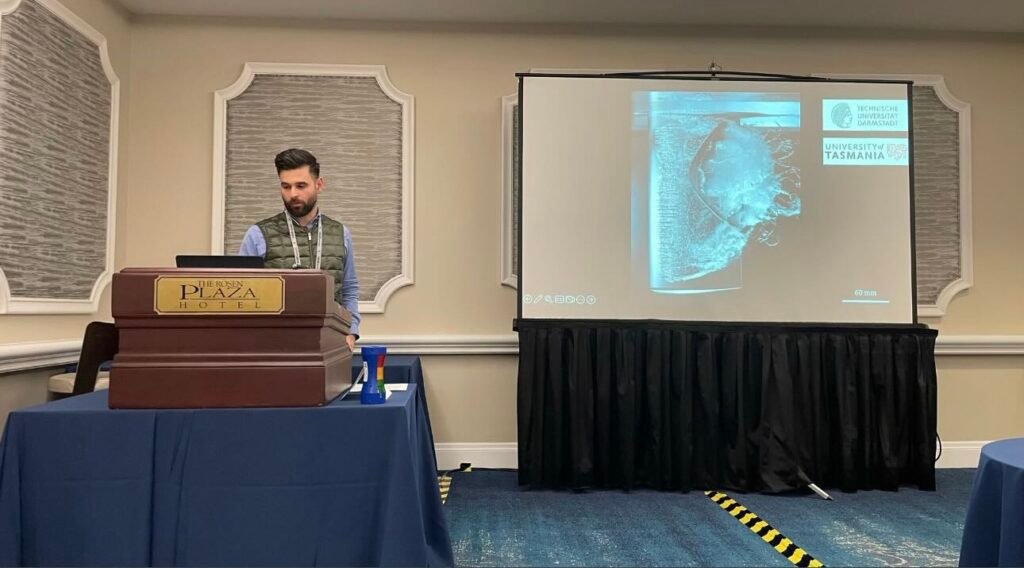
Modal analysis is typically associated with structural mechanics, where dynamic systems oscillate in various modes, each characterised by a specific frequency. These modes represent the way the structure oscillates. But why did I travel all the way to Orlando, Florida, for this conference? As a fluid mechanicist, this may seem an unusual choice. However, the parallels between structural mechanics and fluid mechanics are striking.
In structural mechanics, the system remains stationary within the field of view, but in fluid dynamics, the flow is constantly moving, with new fluid entering from the other side. This difference introduces an interesting challenge. Coherent, periodic structures in fluid flows are difficult to observe with the naked eye, making it necessary to use similar analytical methods as those employed in structural mechanics. By decomposing the flow field into distinct modes, we can analyse the oscillations and their corresponding frequencies – both in space and time – just as we would in structural mechanics.
The conference was an incredible experience. Despite the attendees coming from diverse fields, it was fascinating to see how many of us applied similar methods to address different problems. The shared vocabulary made communication easy and engaging. I had the opportunity to present the how the filter size of the Spectral Proper Orthogonal Decomposition (SPOD) from Sieber et al., JFM, 2017 affects the results regarding high-speed images of cloud cavitation, as well as its extended version (Sieber et al., J. Eng. Gas Turbines Power, 2016) which allows to include additional quantities measured simultaneously. I would gladly attend this conference again – it was truly a valuable experience.